

Issue #10: Resource Asymmetry.
Why corporate ventures get the wrong resources at the wrong time? Part 4 of 6 in Corporate Venturing Under Constraint.


This issue is part 4 of a 6 issue arc on Corporate Venturing Under Constraint.
The signal that arrived too late.
A corporate venture team identifies a strong signal in Q2. The signal indicates retention is compounding, and that a customer segment is emerging that the team did not anticipate but cannot ignore. They need to commit resources to it now, while the signal is still hot.
The annual budget was set in November. Headcount was approved in January. The next planning cycle begins in nine months.
By the time the resources arrive, the window has narrowed. Sometimes it has closed. The venture continues, but the version of the venture that gets resourced is not the one the signal called for. It is the one the budget could accommodate.
This is not bureaucratic resistance. The CFO is not the antagonist. The planning team is not obstructing innovation. Each part of the system is doing what it was designed to do. The system itself was built for a different job.
Corporate ventures do not fail from under-funding. They fail because the resource system is running on the wrong clock at the wrong scale.
This pattern holds whether the venture is built internally, spun out as an independent entity, invested in through corporate venture capital, acquired through M&A or acqui-hire, or pursued through partnership.
The execution path changes. The structural condition does not.
This is a different argument from the one most readers expect as many discussions about innovation funding focus on volume. Addressing questions such as how much capital is allocated, what proportion of revenue is committed, and where the budget sits in the organisational chart. That conversation matters, but it is the second-order question. The first-order question is whether the resource system can move at all when evidence demands it. Volume without velocity is the most expensive failure mode in corporate venturing. It produces big and late.
The deeper diagnosis.
Issue #9 named the absence of reallocation as a portfolio-level failure. A real portfolio redistributes resources when signals strengthen. Most corporate innovation portfolios do not. That essay left a question unresolved. Even when the portfolio decides to reallocate, can the underlying resource system enforce the decision? The answer, in most cases, is no.
The reason is upstream of any particular budgeting failure. Most resource problems in corporate venturing trace to a single structural decision. Innovation is treated as a contained function with a fixed allocation, rather than as a distributed capability with a claim on enterprise resources. The innovation team has its budget. The ventures within it compete for that budget. They do not have a structural mechanism to draw from elsewhere when signals justify it.
Once that classification is made, four downstream conditions follow. Two govern cadence. Two govern volume. Together, they produce the asymmetry the title names.
Cause 1: Ventures are governed on Calendar Time, not Venture Time
Corporate planning runs on calendar time. There is an annual budget with an annual headcount plan, all being managed through quarterly reviews. The calendar is a rhythm imposed for reasons of accountability, forecasting, and governance. Those reasons are legitimate for established business units operating on year-over-year improvement cycles.
Ventures do not operate on calendar time. They operate on venture time, a composite of three distinct rhythms.
There is “evidence time,” when signals strengthen, and the venture has new information about what should happen next. Evidence cycles run in weeks or months, not years. A retention curve that compounds in Q2 is information the team did not have in Q1. Acting on it in Q4, after the next budget cycle, is acting on a snapshot of a market that has moved.
There is an “opportunity time”. When external windows open and close on market clocks, the corporation cannot influence them. A venture round worth participating in. A target available for acquisition. A partnership that becomes possible because a particular configuration of buyers, suppliers, and competitors has briefly aligned. Opportunity time is the world telling the venture when it must move. The corporate calendar is irrelevant to it.
There is an “ad-hoc” time component. Unscheduled but consequential moments. A spin-out is succeeding faster than expected and needs additional staff before the next hiring round. A partnership requiring fast technical resourcing to meet a contract milestone. A pilot showing enough signal that a step-change investment is warranted before the next gate review.
Calendar time is one rhythm, but Venture time is three. The mismatch is not occasional; it is constant. The corporate planning cycle was never designed to accommodate any of the three, because the operations it governs do not require them.
Cause 2: Talent lock-in once deployed
The first cadence problem is about putting resources in. The second is about moving resources between ventures once they are in.
Capital can be reallocated faster than people. A venture that needs less can have its budget trimmed at the next quarterly review. A venture that earns more can have funding lifted. The money moves quickly once the decision is made.
People do not move on the same clock. Once a person is deployed onto a venture, redeploying them onto a stronger signal elsewhere in the portfolio requires unwinding a network of arrangements. Performance reviews are linked to the current scope. Manager relationships have been built. Career narratives have been constructed around the current venture. HR systems treat redeployment as a re-hire process, not a reallocation. Even when the portfolio decides to concentrate talent on the strongest signal, the system makes the decision unenforceable on any timeline that matters.
This is the second clock, and it is often slower than the first. A portfolio with fast capital reallocation and slow talent reallocation is still a portfolio that can change its slide deck but not its execution. The same dynamic applies in spin-outs, where pulling additional people into a successful spin-out from the parent often runs through the parent’s HR cycle. The spin-out’s capital independence does not extend to the flow of talent.
Cause 3: Resource competition with the core business (the floor)
Cadence is one face of the asymmetry. Volume is the other.
When ventures sit inside the corporate budget process, they compete with established business units for resources from the same pool. Every additional dollar to a venture is a dollar removed from a known-return P&L line. The CFO does not need to oppose innovation. The budget structure does it for them.
The rational response, given that comparison, is to set the venture allocation low. Low enough that it does not threaten any meaningful business unit line item. Low enough that approval is uncontested. Low enough that no individual decision-maker has to defend a transfer of capital from operations to experimentation.
This produces a structural floor where ventures get just enough to keep going, never enough to compound. The result, the venture does not have the funding the signal would justify. In CVC structures, the same pattern appears at the deal level. A corporate venture fund weighing follow-on participation in a hot round against operating returns will write a smaller cheque than the round requires. The fund is in the room. It is not in the round at the level of strategic interest it warrants.
Cause 4: No concentration mechanism for compounding signals (the ceiling)
The volume problem has both a ceiling and a floor. Even when a venture earns the right to more resources through evidence, there is no mechanism to concentrate capital on it excessively.
A venture that doubles its retention curve does not automatically receive double the budget. A spin-out that signs a major customer ahead of plan does not automatically secure step-change follow-on capital from the parent. An acquisition target whose strategic value has become obvious does not automatically jump to the top of the M&A queue. Each of these requires a fresh approval against the same competing claims as before. The system can fund maintenance. It cannot fund conviction.
This is the structural difference between a venture portfolio and a venture system. A portfolio decides which bets to make. A system decides which bets to concentrate on as evidence accumulates. Without a concentration ceiling, every venture in the portfolio is funded as if it had the same compounding probability, regardless of the evidence.
The cumulative cost
Each cause is bearable in isolation. A venture operating under all four conditions is not. The system funds these ventures at exactly the level required to keep them alive and exactly nothing more, which is the slow accumulation of stalled ventures, Issue #9 named.
The four resource states
Cadence and volume are not coequal. Cadence is upstream. Volume is downstream. A fast clock with thin volume can still read signals and place small bets. A slow clock with heavy volume produces capital that arrives after the signal has decayed. The 2x2 below maps the four states corporate innovation functions occupy.
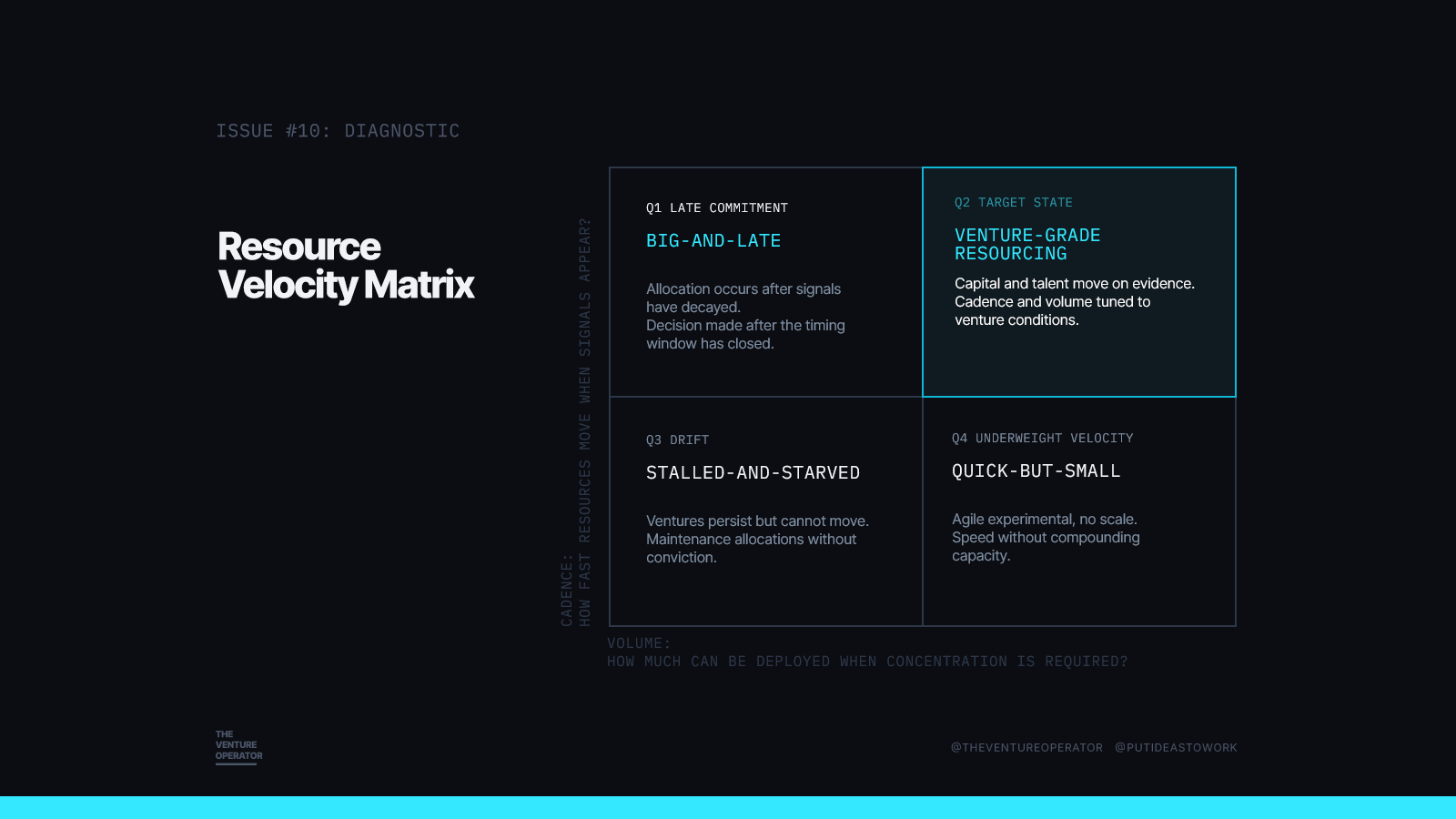
Most corporate innovation functions live in the top-left quadrant. Some, after a budget increase that did not include a cadence redesign, move to the bottom-left and discover that more money on a slower clock produces larger zombie pilots, not better ventures. A few, usually structurally separated from the parent, sit in the top-right. The bottom-right is where venture-grade execution actually happens. It is also where most corporate innovation functions claim to be.
The four exits
Most readers will already be reaching for reasons their organisation is exempt from this argument. Four exits, in order of how often they are used.
We have a fast-track process for urgent resourcing.
Many fast-track processes are political escape valves, not structural mechanisms, depending on a senior sponsor invoking them. They run on relationship capital, not governance design. A fast-track that requires a leader to personally champion each invocation is not a system. It is a workaround that works once or twice a year, then collapses. A real cadence correction does not require anyone to champion it. The default cadence is the fast cadence.We have an innovation fund. That is our pre-authorised pool.
Named innovation funds are often accounting re-classifications of the same annual budget. The capital lives within the pool, but the cadence and volume rules governing its release remain unchanged. The pool cannot be deployed without going back through the business unit planning cycle, without a quarterly committee, or without an exception process that takes longer than the signal allows. A pool you cannot deploy on venture time is not a venture pool. It is a labelled bucket inside the existing system.We have a governance committee that can make resource decisions.
A quarterly meeting committee cannot operate on venture time. A committee that requires consensus cannot concentrate capital on a single signal at the expense of others. A committee whose members each represent a different function will optimise for proportionality rather than conviction. The committee is not the answer to absent decision rights. It is often the structural reason that decision rights are absent.The real problem is we just need a bigger innovation budget.
This is the most expensive exit. Volume without velocity is dead capital. BCG’s 2024 research found 83% of leaders rank innovation as a top-three priority, while only around 30% feel ready to execute. Adding to the volume side cannot close that gap while cadence remains untouched. A larger budget on the wrong clock does not produce more ventures. It produces more zombie pilots with bigger headcount lines.
What changes
The fix is structural, not procedural. A faster approval process inside the existing architecture will not produce venture-grade resourcing. The architecture itself has to change, with a mechanism that enables the venture pool to sit outside the annual planning cycle. This is not a labelled bucket. A genuinely separate structure with its own governance, its own decision rights, and its own deployment triggers.
Governance
The pool is governed by a small group with explicit authority to deploy capital and assign talent on evidence triggers, without requiring approval from the next BU planning round. The group is structurally separated from the operating P&L, which means its decisions cannot be vetoed by line-of-business managers protecting their allocations. The group’s accountability is for the ventures that pool resources, not for the operating revenue lines those resources might have served instead.
This structure is not unfamiliar. It is roughly how independent venture firms operate: a partner group with capital deployment authority, evidence-based decision triggers, and accountability to a portfolio rather than to an operating P&L. The novel work in a corporate context is making the structure compatible with the rest of the organisation without surrendering its independence.
Triggers
The pool deploys on evidence triggers, not on calendar triggers. A retention curve crossing a defined threshold. A customer concentration signal exceeding a stated level. An external event such as a competitor move, a regulatory change, or the availability of a target. A spin-out hitting a milestone that warrants follow-on. The triggers are documented, monitored, and acted on without requiring fresh approval each time.
This does not mean the pool deploys without evaluation. It means the judgment runs on the venture’s clock, not the corporation’s. A trigger fires, causing a decision within the pool’s governance. Capital and talent move. The annual planning cycle does not need to be known in advance.
Size
The pool needs to be large enough to fund concentration, not just continuation. If the pool can support only N ventures at the maintenance level, the concentration ceiling remains unchanged. The pool must carry headroom for a step-change investment in the strongest signal, meaning it must be sized as if at least one venture will require multiples of its initial allocation. A typical starting frame: pool size equal to two to three times the sum of initial venture allocations, with explicit reserves for follow-on concentration.
The pool fixes cadence first. It also creates the structural conditions for volume to flow to the strongest signals, because there is somewhere for that volume to go without contesting BU allocations.
The pool addresses capital cadence. Talent cadence requires a parallel structure, with pre-authorised talent slots that are reassignable on evidence triggers, and HR treating venture redeployment as strategic rather than a re-hire. Without that, the pool can move money but not people.
Diagnosing Resource Velocity
Six questions. Three on cadence. Three on volume. Each has a named failure mode. Apply this to your own innovation function. Answer honestly.
Cadence
When was the last time your innovation function reallocated capital outside the annual planning cycle? If the answer is “in the last quarter,” you have a working cadence. If the answer is “during last year’s reset,” or you cannot recall, you do not.
Failure mode: You have a calendar, not a clock.If a venture team identified a strong signal next month, how long until additional capital and headcount could be deployed in response?
Measure the answer in weeks. If the answer is in quarters, the signal will have decayed by the time the resourcing arrives.
Failure mode: signal-to-deployment lag is measured in quarters, not weeks.What evidence threshold triggers an out-of-cycle resource decision in your governance system?
If you can name the threshold, you have evidence-based cadence. If the answer is “when the CEO asks,” you have political cadence.
Failure mode: there is no threshold, only a calendar.
Volume
When a venture demonstrates compounding evidence, can it secure step-change resourcing without joining the next BU planning round?
If yes, you have a concentration mechanism. If no, the venture is graded on a curve set by the core business.
Failure mode: Ventures are evaluated against operating returns, not venture returns.Is there pre-authorised capital sitting in a venture pool, or does every increment require fresh approval against competing BU bids?
A pool you cannot deploy without re-approval is not a pool.
Failure mode: Venture capital is contested capital.Is there a defined ceiling on how much a single venture can absorb when signals justify concentration, or does every dollar above baseline require an exception?
If your strongest venture cannot draw step-change resources without exception treatment, your system is designed to maintain ventures, not to bet on them.
Failure mode: your system can fund maintenance but not conviction.
Reading the pattern
Five or six yes answers: you have venture-grade resourcing. Confirm by reviewing how the system performed under pressure in the last 24 months.
Three or four yes answers: one axis is functioning while the other is broken. Identify which. Cadence-strong / volume-weak organisations make many small bets quickly, but cannot concentrate when one of them works. Volume-strong / cadence-weak organisations have meaningful capital that arrives after the signal has decayed. Both states are unstable.
Less than three positive answers: you are operating in stalled-and-starved territory. The portfolio is on the wrong clock at the wrong scale. The structural fix is upstream of any particular budget conversation.
The Australian context: A capital constrained ecosystem.
The cost of resource asymmetry compounds in capital-constrained ecosystems. Australia is one such ecosystem, and four features make the structural argument harder to escape locally.
A decade of mixed venture outcomes
The most publicly documented Australian evidence sits in corporate venture capital, because external investments leave a paper trail and external structures attract external commentary. The same structural conditions apply to internal builds, spin-offs, M&A, and partnerships, but those failures are usually invisible outside the organisation. The CVC story below is illustrative, not definitional. The same patterns play out across every execution path.
Over the last ten years, each of Australia’s major banks built corporate venture vehicles. Their structural designs differed materially.
Some were internal funds governed under the parent’s financial architecture.
Some were spun out into independent entities with the parent as sole funder.
Some were externally-managed funds with the parent as one limited partner among several.
Some were venture scalers with partial separation: a separate legal entity and technology stack, but inside the parent’s strategic gravity.
The outcomes have not divided cleanly along the lines most people would predict. Externalisation alone has not been the answer. Internal models have not always failed. The variable that better explains durability is something more specific: how robust the structural separation was, and how much it depended on the parent’s continued willingness to fund and not interfere.
One of the major banks set up an internal innovation and investment arm. Close to a decade later, it had evolved and was spun out into an independent entity, to operate outside the “gravitational pull” of the parent entity. Thereby, driving improvements across delivery speed, agility, lower costs, and easier talent recruitment. The entity ran for several years. with several meaningful investments, including a position in one of Australia’s most successful fintechs. In late 2025, under new leadership and amid a broader restructure, the bank closed the entity. The remaining portfolio was folded back into a non-operating holding company. The structural fix had been correctly implemented and then unwound.
A different bank ran an internal fund for several years and approximately $100M of deployed capital before substantially slowing its activity. The fund still exists and still has a public-facing investment process and a portfolio, however new investments have dropped from its peak. The structural separation was real. The funding potentially was not over time.
A third, took a different mode, operating a venture scaler, with partial separation, that started with a stated ambition of 25 ventures by 2025. It has since re-positioned to scaled back on volume, to fewer but larger bets. It too more recently has extended its model through a partnership with an external fintech fund.
And a fourth, the earliest mover, structured its CVC as an externally-managed fund with the bank as a limited partner. That fund made early bets that produced material returns, including a position in a US crypto exchange that yielded a reported $500M-plus windfall on listing. It ran three funds. Ahead of its fourth fund, it decoupled from the bank, partly because the bank was reluctant to back the categories the fund manager wanted to pursue. The fund continues to operate. It is no longer a pure corporate venture vehicle solely for its parent entity.
Two patterns matter in this evidence.
The first is that the durability of separation explains more than the presence of separation. Independent entities funded solely by the parent have a weaker form of structural separation than independent funds with diversified limited partners. The kill switch is in different hands. When the parent’s leadership changes or its cost pressure rises, the parent-funded entity is exposed in a way the diversified-LP fund is not.
The second is that even correctly implemented structural fixes are not durable unless they are institutionalised beyond any single leadership team. The structural argument the essay has made operates over decision cycles measured in months. Corporate leadership cycles run on multi-year clocks. A venture architecture that depends on the goodwill of a particular CEO will be vulnerable at the next transition, regardless of how well it was designed.
The lesson is not that externalisation is the answer. It is that resource architecture is the binding constraint; the architecture has to be designed for durability rather than initial separation, and the durability has to be earned over time and across leadership transitions, not just established at inception. The structures that survived longest in the Australian evidence were those whose continuation did not depend on any single corporate decision-maker continuing to back them.
The same pattern, less visible: internal builds and spin-outs
The CVC examples above are documented because external investments leave a paper trail. The much larger pool of evidence sits in internal builds, where the structural pattern is identical but the failures are visible only inside the organisations that own them.
The pattern is recognisable. An internal venture is launched with a strategic mandate. It receives an annual allocation that is rational by core-business standards but starves it by venture standards. It runs for several years. Customer acquisition is steady but slow. Headcount lifts incrementally. The product roadmap moves at the cadence permitted by the parent’s planning cycle. Years later, when the organisation needs to accelerate to keep up with a market that has moved, the internal venture cannot. The acceleration option chosen is usually external: a competitor neobank is acquired, an external partnership is signed, a fintech is bolted on. The structural problem the internal build was designed to solve is eventually solved by paying market rates for someone who was free to operate on venture time.
One Australian example sits in plain view. A major bank launched an internal direct bank in 2008. Roughly thirteen years later, with a customer base that had grown but had not kept pace with newer entrants, the parent bought a younger competitor folded it into the original venture, taking the competitor’s technology platform and team alongside the original brand.
The internal build was not a failure. It worked, by every measure the parents’ planning cycle had set for it. It was simply unable to meet the market’s timeline. The acceleration had to be purchased externally because the parent’s architecture could not generate it.
That is the structural pattern at the internal-build level. The venture had funding for over a decade. What it did not have was the cadence and concentration mechanism to compound. The eventual fix was not to redesign the resource architecture. It was to acquire what the architecture had failed to produce. That works once. It does not work as a system.
The acquisition pattern reveals the same condition from a different angle. When organisations cannot resource at venture velocity internally, they buy. The acquired venture often arrives with the velocity intact, only for the integration process to destroy it. Bain’s M&A research has found that talent retention is the second-largest contributor to acquisition deal success, behind only deal thesis. Acquired venture teams that operated on venture time before acquisition find themselves slowed to the parent’s pace within the first integration cycle. The volume problem has been solved by the acquisition price. The cadence problem has not.
If an organisation repeatedly chooses to buy what it cannot build internally, the binding constraint is not capability or talent. It is a resource architecture. The pattern may repeat every five to seven years.
A capital ecosystem that compounds the cost.
The Cut Through Venture and Folklore Ventures State of Australian Startup Funding 2025 report shows the structural shape of local capital. $5.48 billion was raised across 390 deals in 2025, but the top 20 deals captured 58% of the total. Series B remains a bottleneck, and 66% of all 2025 deals included at least one international investor, up from 57% in 2024. At Series A and beyond, offshore participation is now the norm rather than the exception.
For corporate ventures, this matters because the fallback option after missing an internal resourcing window is much narrower than in deeper capital markets. A US-based corporate venture that misses its parent’s funding window can usually find domestic bridge capital. An Australian corporate venture that misses its parent’s window often cannot. Internal cadence is not just a governance question. In Australia, internal cadence often is the capital availability for corporate ventures.
A concentrated corporate landscape.
our banks. Three miners. Two insurers. Annual planning cycles in these organisations are not just embedded, they are load-bearing. The structural mismatch between calendar time and venture time is therefore especially costly here, because the organisations most likely to operate corporate venture functions are also the ones with the most deeply entrenched planning architectures.
The Australian innovation ecosystem cannot fix the cadence problem from the outside. The fix has to come from inside the organisations that hold the largest balance sheets, and the design of that fix is the structural question this issue has tried to name.
A doctrine close.
Volume without velocity funds zombie pilots. Velocity without volume funds experiments. Ventures need both.
A corporate venture system running on the wrong clock at the wrong scale is not a venture system. It is an operational system with a venture label. The label provides cover. The structure produces the outcomes the structure was designed to produce. Calendar time and contested volume produce stalled ventures. Venture time and pre-authorised concentration produce ventures.
Issue #9 ended on the line that a portfolio without kill discipline is just a list. Issue 10 extends that argument one structural layer down. A portfolio without resource velocity is just a list with a budget.
Closing note
This is Issue #10, the fourth or six in the Corporate Venturing Under Constraint series. Issue #9 named the absence of reallocation as the portfolio-level failure. Issue #10 has named the resource architecture that makes reallocation unenforceable.
Still to come:
Issue #11 takes up the question this issue leaves open: who, inside the organisation, holds the authority to design and operate this architecture in the first place. Governance maturity. Decision rights. The role that does not yet exist in most corporate innovation functions.
Issue #12 closes the series by naming the function itself. The Venture Operator Function a category that this body of work has been describing.
If you found this useful, the diagnostic above is designed to be run on your own function. Save it, screenshot it, share it with someone who needs to see it. The structural conversation is easier to have when both parties are looking at the same diagnostic.
This essay is based on the author's professional experience and interpretation of publicly available information. It is provided for general informational purposes only and does not constitute advice. Any views expressed are the author's own and do not refer to any specific organisation, program, or individual.
References & Further Reading
Bain & Company. (2022). Reimagining Talent in M&A: 2022 M&A Report. https://www.bain.com/insights/reimagining-talent-m-and-a-report-2022/
Boston Consulting Group. (2024). Most Innovative Companies 2024: Innovation Systems Need a Reboot. https://www.bcg.com/publications/innovation-strategy-delivery-insights
Capital Brief. (October, 2024). x15 Ventures celebrates first major ‘exit’ as Unloan graduates into CBA division. https://www.capitalbrief.com/article/x15-ventures-celebrates-first-major-exit-as-unloan-graduates-into-cba-division-40a3cdc7-fd35-4b61-8cbe-cf996c92780d/
Capital Brief. (October, 2025). ‘Makes sense’: ANZ confirms 1835i closure. https://www.capitalbrief.com/newsletter/makes-sense-anz-confirms-1835i-closure-4c965396-a6f1-45ee-bd68-3df1167291f5/
Capital Brief. (December, 2024). ‘Pleased it’s over’: Ubank CEO on the 86 400 merger and the neobank’s future at NAB. https://www.capitalbrief.com/article/pleased-its-over-ubank-ceos-on-the-86-400-merger-and-the-neobanks-future-at-nab-649af10e-6eab-4e2a-aa91-adb62100144f/
Capital Brief. (August, 2024). From Reinventure to reinvention: Westpac’s mutating VC journey. https://www.capitalbrief.com/article/from-reinventure-to-reinvention-westpacs-turbulent-vc-journey-418322dc-ff80-4f50-954b-917e6330831f/
Collective Campus. Corporate Venture Capital in Australia: Fueling Innovation and Growth. https://www.collectivecampus.io/blog/corporate-venture-capital-in-australia-fueling-innovation-and-growth
Cut Through Venture and Folklore Ventures. (February, 2025). State of Australian Startup Funding 2025. https://www.cutthrough.com/insights/state-of-australian-startup-funding-2025
iTnews. (June 2022). CBA’s x15ventures switches focus from build to benefits. https://www.itnews.com.au/news/cbas-x15ventures-switches-focus-from-build-to-benefits-580793
Mi3. (December, 2023). Fewer, bigger bets: CommBank’s X15 ventures doubles down on scaling winners. https://www.mi-3.com.au/05-12-2023/banking-deeper-tech-integration-and-innovation-drive-customer-loyalty-well-commercial
Startup Daily. (October, 2025). ANZ bank has killed off its venture arm, 1835i. https://www.startupdaily.net/topic/venture-capital/anz-bank-has-killed-off-its-venture-arm-1835i/