

Issue #1: The First Test - How to know if an idea is worth solving
Why most ideas fail before execution even begins?


Before you build anything, test the problem, not the solution.
Here is the fastest way to know whether an idea deserves your time.
The Familiar Failure
Many of us who work with, advise, or invest in founders have seen this pattern.
A founder presents an early-stage venture deck or a polished working prototype.
There is a thoughtful UI. Clean logic. Weeks of work evidenced. And sometimes even $40K spent.
They have spoken to people.
They have had meetings.
They have heard encouraging feedback.
“This is interesting!”“I’d definitely use something like this.”Two weeks later, the idea is dead, if they are lucky. Some continue for months or even years. Not because the solution was wrong. Not because the execution was poor.
But because the problem was not real.
What it means for a problem to be NOT real?
A problem is not real when there is:
No workaround.
No urgency.
No repeated behaviour.
No signal anyone cared enough to act.
The founder did not misread their idea. They misread the problem. It was not worth pursuing, at least not yet.
That is where The First Test begins.
A Venture Operator’s First Test
If you want to know whether an idea is worth pursuing, start with one question:
Is this a problem people are already expending effort to deal with today?Not could, should or might once a product exists.
But what people are actually doing right now, in the absence of a good solution.
Across technology, sector, healthcare, deep tech, and research-led domains, real problems create observable behaviour.
That behaviour may look different by domain, but it always exists when demand is real.
Reading demand signals in the wild
In practice, demand shows up as people paying a price to cope.
That price may include:
manual effort and workarounds including spreadsheets, scripts, shadow systems, repeated manual tasks
risk, delay, and mitigation including interim protocols, monitoring regimes, acceptance of known limitations
a form of spend such as time, money, external consultants, political capital, compliance overhead
The form varies by domain.
The signal does not.
Where behaviour exists, there is demand.
Where behaviour does not exist, there is no evidence of urgency.
Assessing signal strength
To make this concrete, ask:
Is the problem active, are people taking action today?
What is the workaround? Every real problem produces one.
How painful is it? Pain drives urgency, adoption, and willingness to pay.
What is the cost of the workaround? Time, money, risk, delay, frustration, compliance overhead … all count.
How frequently does this behaviour occur? Recurring pain compounds. One-off pain rarely does.
If there is sustained behaviour, there is an initial signal the idea may be worth exploring. If there is no behaviour, you have noise.
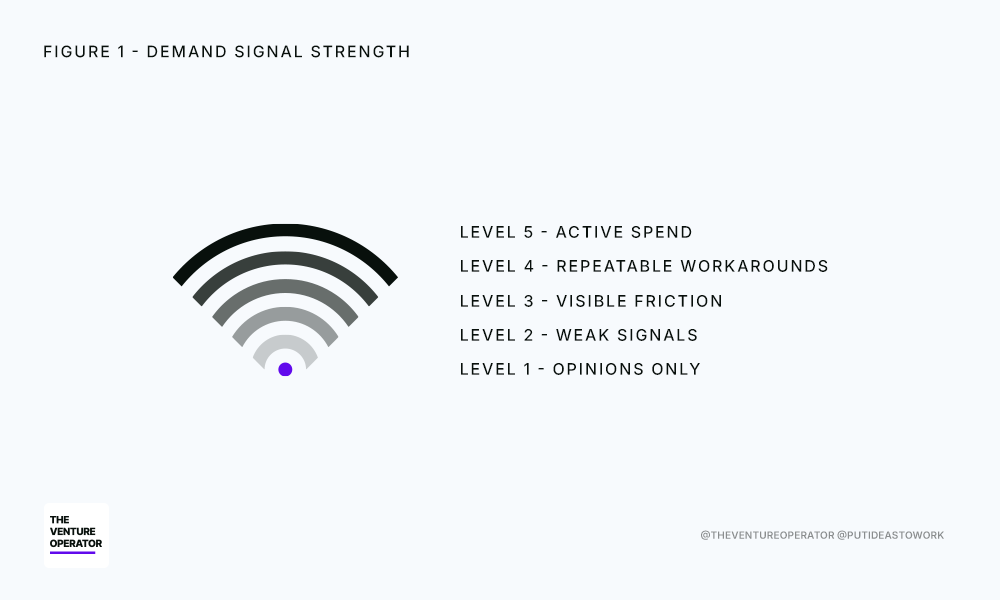
The diagram is not a maturity model. It is not a funnel. And it is not a scorecard designed to make weak ideas feel better.
It is a simply a way to visualise how demand shows up in the real world.
As you move up the levels, you are not moving toward sophistication. You are moving toward observable reality.
At the bottom (Levels 1-2), signals are cheap. People talk, they speculate, they express interest. Nothing changes in how work gets done.
In the middle (Level 3), pain becomes visible. The problem show sup repeatedly. It causes friction, delays,m error or inefficiency. But action is still inconsistent. People tolerate the pain rather than actively compensate for it.
At the top (Levels 4-5), behavior changes. People start doing something about the problem, even if the solution is imperfect. They build workarounds, add manual step, bring tools or external help, therefore spend time, money, political capital or accept the risk to cope.
This is the point where the problem can be considered initially investable.
The diagram is intentionally simple because the judgement it supports is simple:
if people are not already expending effort to deal with the problem, you do not yet have evidence of demand. How strong does the signal need to be?
To justify investment, even your own time, you should be aiming for a signal strength of 4 or 5. Anything below that is speculation.
If the world is not already expending effort to deal with the problem, it will not magically start when your solution appears.
This is not about optimism or belief.
It is about observable reality.
A common objection
This does not apply to healthcare, biotech, or deep tech.
People cannot solve the problem yet, that’s why the innovation is needed.
This objection usually comes from a good place.
In regulated or science-led domains, the final solution genuinely may not exist yet.
But that does not invalidate the test.
It clarifies what kind of behaviour you should be looking for.
What the test is really asking?
The First Test is not about whether the problem can be fully solved today.
It is about whether people are already paying a price to live with it.
In the areas of Medtech, Biotech, Deep Tech and other research-led sectors, that price often appears long before a new solution exists.
For example:
In MedTech, clinicians adapting procedures or workflows to compensate, increased monitoring, manual checks, or secondary confirmation steps or even hospitals absorbing higher operating costs to manage the limitation. These are behavioural signals, even if no one can “fix” the problem yet.
In BioTech or Therapeutics, where there is no effective treatment for an illness or condition, off-label use of existing drugs, multi-drug regimens to manage symptoms imperfectly or funding flowing into adjacent or partial solutions. Again, these are cost-bearing behaviours, not hypotheticals.
For research-led or deep tech domains, even when the core breakthrough does not exist yet, you may still see, organisations investing heavily in mitigation rather than resolution or policy, compliance, or safety layers added to manage known risk. If people are reorganising work, absorbing risk, or allocating capital around the problem, the signal is real.
If people are reorganising work, absorbing cost, or accepting risk around a problem, the signal is real.
“Unsolvable today” does not mean “not urgent.”“No workaround” usually means “no urgency.”Why the Demand Signals Matters
Different audiences. Same failure mode.
The First Test is universal because the mistake it prevents is universal: building before understanding.
However, its value appears differently depending on who you are.
For the founder, it prevents months of building something elegant, impressive and irrelevant. Many early-stage failures are not execution failures; they are problem-selection failures. The First Test forces founders to earn the right to build.
For the corporate innovator, it cuts through internal enthusiasm, political sponsorship and innovation theatre. Internal alignment is not external demand. The First Test recentres the conversation on reality rather than narratives.
For researchers or Universities, it bridges the gap between technical novelty and real-world application. The question shifts from “What could this technology do?” to “Where is the world already struggling without it?
For the investor, it helps to focus on a team that understands markets, not just ideas. It is a fast, cheap initial filter for your pipeline.
That shift is the difference between publications and impact.
Let’s Execute
No workshops. No frameworks. No theatre.
You do not need permission, funding or a team to run The First Test. You need curiosity and discipline.
Write the problem once.
One sentence. Plain language. No solutions.If you cannot do this, stop.Hunt for behaviour.
Look for where the problem already shows up, in workflows, reports, budgets, complaints, manual effort, workarounds, etc. If you cannot find three real examples, you do not yet have a problem.`Validate one workaround.
Talk to the person doing the work. Not what they think. Not what they believe. What they do. Ask them to show you what they actually do. Behaviour rarely lies.Score what you see.
Not emotionally. Not optimistically. But honestlyHow often does this occur?
How painful is it?
What does it cost?
What happens if nothing changes?
High scores earn progress. Low scores earn restraint.Decide.
Proceed, reposition, or pause. Most teams drift. Operators decide.
A Closing Thought
Innovation begins with observation, not invention.
The market leaves breadcrumbs everywhere.
Follow the behaviour. If people are not already solving the problem today with time, money, or effort. It is improbable that people will suddenly start once your product appears. Developing an understanding on this will help you to choose problems that justify your scarce time, capital, and focus.
Novel solutions win. Novel problems do not.
What coming next?
Passing The First Test does not guarantee you are right, or will be successful.
In the next issue, we will look at why even strong-looking demand signals are often misread, how enthusiasm, pilots, sponsorship and alignment can create the illusion of traction.
We will unpack most common false positives, the signals that quietly matter more to help minimise time, capital and credibility are wasted.